

Published Thursday, August 13, 2026 – 13:00
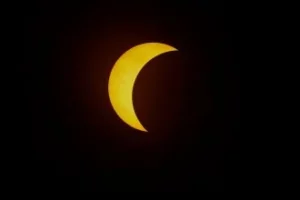
A solar eclipse occurs when the Moon passes between the Earth and the Sun, partially or fully blocking the Sun from view. During the August 12 eclipse, over 90% of the Sun was obscured at maximum eclipse in parts of Ireland.
Although solar eclipses occur frequently somewhere on Earth, the degree of obscuration depends on the observer’s location. Eclipses exceeding 90% obscuration are uncommon for any given place, making this event particularly notable for Irish observers.

Dr Emma Whelan of MU’s Department of Physics said: “Solar eclipses have inspired curiosity and scientific discovery for thousands of years. Events like this allow people to experience that sense of wonder first-hand while learning about the science behind what they’re seeing. They also provide an opportunity to inspire the next generation of scientists, engineers and innovators. Many people working in STEM today can trace their interest back to moments of awe just like this.”
The celebration also featured live astronomy demonstrations and a programme of talks exploring solar science and astronomy. Topics included the nature and history of the Sun, quantum processes within it, solar energy, the Sun’s influence on Earth’s climate, the role of eclipses in the history of physics, and the long‑term fate of our star.
Dr Whelan presented The Story of the Sun, Dr Joshuah Heath explored The Quantum Sun, Dr Marcin Gradziel discussed Electric Power from the Sun: The Good, the Bad, and the Glinty!, and Dr Michelle McCrystall examined the Sun’s influence on Earth’s climate in The Star of the Show: How the Sun Drives Our Climate. Prof Peter Coles presented Einstein and the Eclipse, while Dr Patrick Kavanagh considered the future of our star in Will Our Sun Go Supernova?
The programme also included an inflatable planetarium and hands‑on astronomy‑themed arts and crafts for children.
The August 12 eclipse offered a rare opportunity for people across Ireland to witness an unusually deep partial solar eclipse. The next eclipse of comparable magnitude visible from Ireland is expected in 2090.